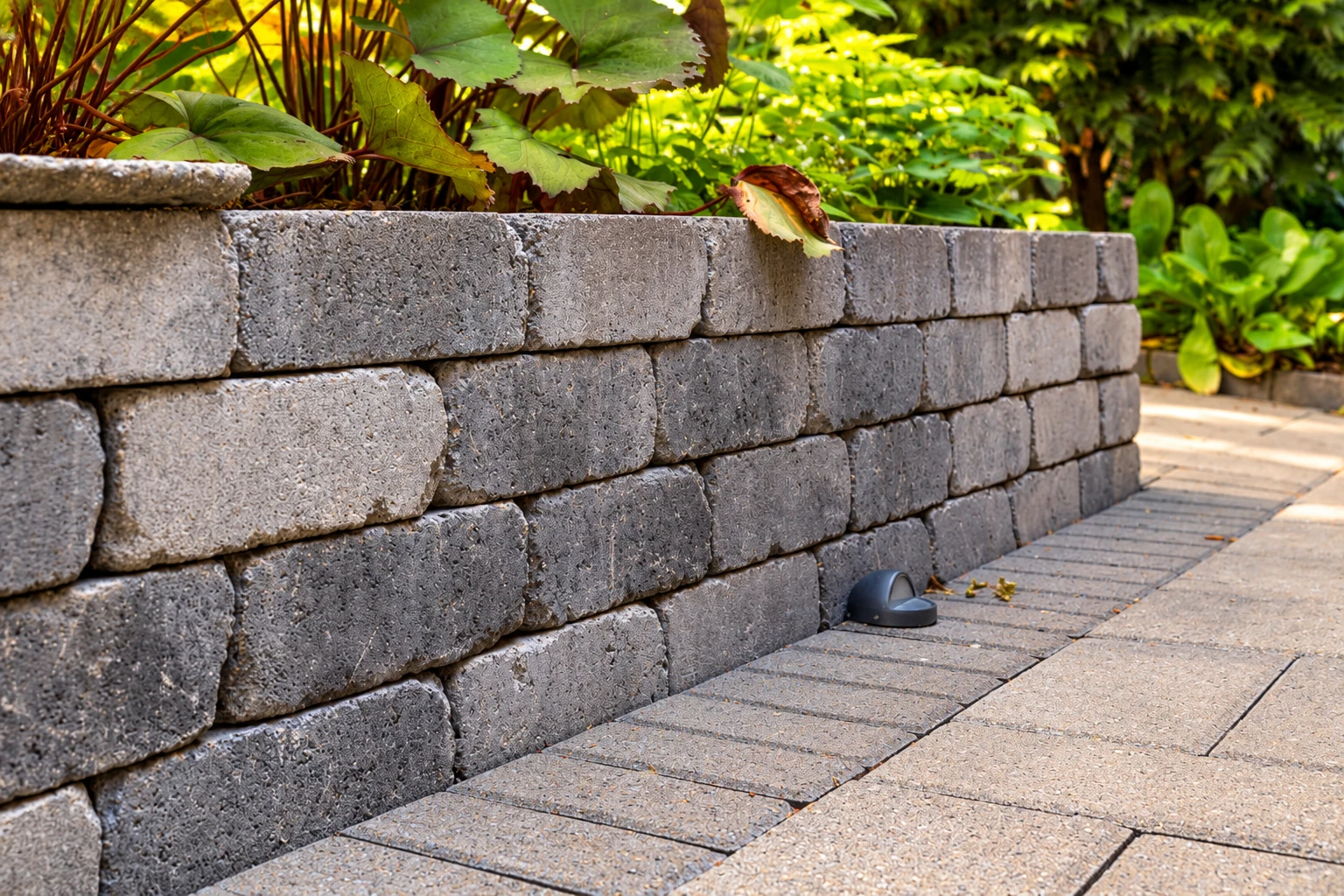
Concrete retaining walls in Maricopa AZ - a wall that drains and holds your yard
Dirt washing onto the patio or a slope creeping into the yard? We pour concrete walls that hold soil back and let water out.
- Fully licensed and insured.
- Free quotes on site.
- We reply within 1 business day.
Do you need a concrete retaining wall in Maricopa?
A concrete retaining wall in Maricopa is a poured concrete or block wall that holds soil back where your yard changes level, so a slope stays put instead of creeping onto your patio, walkway or pool deck.
Most walls I'm asked about start with a back yard that sits higher than the house, a slope cut back to make room for a pool or a new patio, or an old wall that's started to lean. The price moves mostly with the wall's height and length, how much soil it holds back, the footing it needs underneath, the drains behind it and how easily we can get equipment to the spot. The schedule turns on any permit review, what we hit when we dig and the cure, which is the days concrete needs to gain strength before we fill behind it. Where the wall sits on your lot also decides how tall it can be, so I settle that first, and the written estimate I send spells out what's included for your wall.
How can you tell your yard needs a retaining wall?
Dirt washing onto the slab
After a hard rain you find a fan of mud across the patio or walk, which usually means the slope above has nothing holding it and no path for the water. Left alone, it keeps carrying soil down and can start washing out the ground under the slab's edge.
An old wall leaning out
The top tips forward, cracks open across the face or a section has stepped out of line, which usually means water and soil are pushing harder than the wall was built for. A leaning wall doesn't straighten itself, and the longer it goes, the more there is to tear out.
A slope you can't use
Part of the yard is too steep to plant, mow or set a table on, and every project you plan stops at the hill. A wall turns that grade into a level step, and it's easier to plan before you pour the slab or deck that will sit beside it.
How we build a concrete retaining wall
Drainage is the first thing I plan on a wall, because water that can't get out from behind it keeps pushing on it, so I lay out drains you can reach and clear later instead of relying on holes in the face that clog. I also check the city's height rule for that exact spot on your lot before we settle the design. Then we dig out for the footing, the wide concrete base the wall stands on, and pack the ground under it so it won't settle like loose dirt. We set the forms and the rebar, the steel bars inside that keep the wall from bending and cracking under the soil's push, check that it's square and straight up and down, and pour. The wall cures before we backfill, which means filling the space behind it with gravel around the drains and then soil, and we clean up when we're done. If the budget gets tight, I'd rather trim the finish on the face than the footing or the drains, because you can redo a face, and you can't easily redo what's under and behind a wall.
A wall usually changes the concrete next to it. If it's cutting into a slope to make room for a pool, we can plan the concrete pool deck so it drains away from both, and if it's leveling ground for a shop, casita or garage, we handle the concrete floor installation on the ground it holds.
Poured concrete cantilever wall
A poured wall with steel running from the footing up into the upright stem, where the footing reaches back under the soil so the soil's own weight helps hold it in place. It suits taller walls on firm ground where you want one solid piece with a clean face.
Concrete block wall
Block laid on a poured footing with steel and grout filling the cores, often finished with stucco and a cap. It suits a wall you want to match a block fence or the house, and it handles curves and steps in height well.
Low seat or planter wall
A short wall at the edge of a patio or bed that holds a raised planter or doubles as a bench. It suits front yards and small grade changes where a tall wall isn't needed or isn't allowed.
Get a written estimate for your retaining wall
Send the form and we'll reply within one business day to set a time. I come out, measure the slope and send a free written estimate, and there's no obligation to go ahead.
(602) 847-8405- office@concretemaricopa.com
- Based in
- Maricopa, AZ 85138
- Hours
- Mon–Fri: 8 AM–10 PM, Sat–Sun: 6 AM–9 PM
What happens after you call about a retaining wall in Maricopa?
Here's how a wall goes from your first call to the last load of fill, and who you'll be dealing with at each step.
Call or send the form
We get back to you and set a time for me to come out. If the slope is hard to reach, mention it, since access shapes the plan.
I measure and write it up
I measure, look at what's there now and the ground underneath, and send a written estimate that spells out what's included, from the footing and drains to the backfill. You see the full scope before you decide anything.
We line up permits and prep
Once you say go, we line up any permit and inspection the wall needs, then dig out and check the base under the footing. The pour waits until that base is right.
I run the pour and backfill
I'm on site from the pour through the finish. The wall cures before we fill behind it, and we leave the site clean.
Why Maricopa homeowners call United Maricopa Concrete Construction for retaining walls
I measure and run it myself
I come out to measure and look at the slope myself, and I'm on site running the crew while they form, place and finish the wall. The person who planned your drains is the one watching them go in.
Set tile before pouring concrete
I set tile for years before I switched to concrete, and a lot of the cracked floors I tiled over came down to a rushed slab underneath. I started this business in 2023 so the work under the surface gets the time it needs.
We look for caliche first
Caliche, soil cemented hard by calcium carbonate, is a common problem in southern Arizona and can form a solid layer from a few inches to several feet thick. I check for it when I measure, because it changes how we dig the footing and how water moves behind the wall.
Licensed and insured on every job
We're fully licensed and insured, and you're welcome to check both before you sign anything. That's worth asking of anyone building a wall that holds soil next to your house.
If a slope is crowding your yard or an old wall has started to lean, send us the details or call (602) 847-8405, and I'll come out and take a look.
Retaining walls, pool decks and slabs in Maricopa
In Maricopa, where the wall sits on your lot sets how tall it can be. In residential districts the city code allows a retaining wall up to three and a half feet in a required front or street side yard and up to six feet in a required side or rear yard, so the spot you pick shapes the whole design. The City of Maricopa's Building Safety guides cover building permits, and a wall starts with the city's Fence and Wall Guide. We take care of the permit paperwork and schedule the inspections when a job needs them, and if it isn't clear whether your wall does, we ask the city's building office before work starts.
The ground matters as much as the rules. The Arizona Geological Survey says expansive soils, which swell when wet and shrink as they dry, and collapsing soils, which can drop when they get soaked, are found throughout Arizona, though not on every lot. Washington State highway design guidance says cantilever walls and rigid gravity walls, the heavy kind that hold by their own weight, tolerate settling least and aren't used where ground is prone to it, so on a lot that may move I'd talk through a different kind of wall with you. We meet the same mix of ground on jobs in Casa Grande and Chandler.
Questions about retaining walls in Maricopa
How much does a concrete retaining wall cost in Maricopa, AZ?
A concrete retaining wall in the Phoenix area usually costs about $13 to $38 per square foot of wall face, the side you see, and that's the area's going rate rather than our price. Height, length, footing, drains and access set where yours lands, and Washington State highway guidance notes that walls that are tall but short in length cost more because equipment has little room to work, as do remote sites and hard access. My written estimate gives you the figure for your wall and what it covers.
What causes a concrete retaining wall to fail?
Poor drainage is by far the most common reason retaining walls perform badly, according to national research on retaining wall drains, and those problems can grow into outright failure. Weep holes, small openings that let water seep out through the face, ease the pressure but are likely to clog over the wall's life, and drains that can be maintained are the more reliable way to keep a wall draining. Drainage is the first part of the plan I'd ask any contractor about.
Can I build my own retaining wall in Arizona without a contractor's license?
Yes, Arizona's contractor licensing law doesn't apply to owners building or improving their own property, whether they do the work themselves or with licensed contractors. That holds when the work is for your own occupancy, not to sell or rent out. If you'd like to handle part of it yourself, I'm glad to talk through which pieces make sense for us to take.
How do I know if the soil on my lot will move under a retaining wall?
The surest way, according to the Arizona Geological Survey, is to have a reputable geotechnical firm, a soil engineering company, take soil borings and test how expansive the soil is. I look at the ground when I measure, and if something gives me pause, I'd want that testing done before we settle on a wall type.
When can you backfill behind a new retaining wall?
You backfill once the wall has gained enough strength to take the soil's push, or once it's braced, which is what trade guidance for block walls calls for. The same guidance says to keep heavy equipment back from the top of the wall by a distance equal to its height while filling, and that's a fair question to ask any crew.
How do I get a retaining wall estimate in Maricopa?
Call (602) 847-8405 or send the form with where the wall will go on your lot, its rough height and length, and a few photos of the slope. That spot tells me which height rule applies, and the photos help me plan the visit before I come out to measure.
Other concrete work that often goes with a wall
Concrete pool decks
If the wall is cutting into a slope to make room for a pool, the deck around it should drain away from both the water and the wall.
Concrete floor installation
Leveling a sloped lot for a casita, shop or garage usually means a new floor slab on the ground the wall holds, poured on a packed, checked base.
Service areas around our Maricopa base
United Maricopa Concrete Construction is based in Maricopa, Arizona, and builds retaining walls across the six cities with their own pages here, including Sun Lakes and Tempe. We work in other cities around Maricopa too, so call even if yours isn't listed.
Maricopa, AZ
Get your retaining wall measured and planned
Settling the drains and the height for that spot on paper costs a lot less than changing them after the forms are up.